
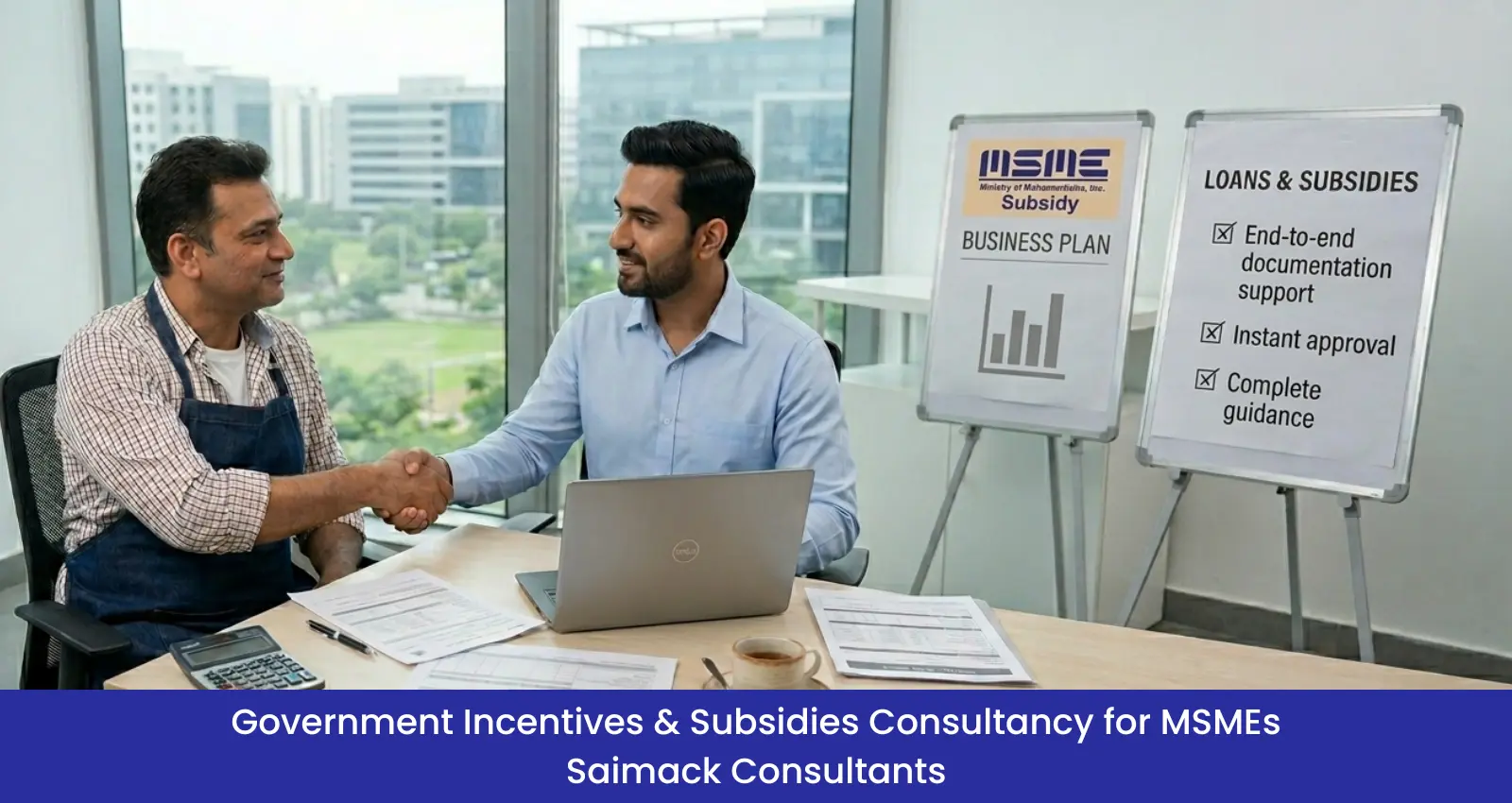
Every year, thousands of MSMEs across India leave crores of rupees in government subsidies unclaimed, not because they don’t qualify, but because they don’t know where to look or how to apply.
At Saimack Consultants, we change that. With 4+ years of hands-on experience, 100+ clients served, and a 4.9-star rating on Google, we provide end-to-end consulting to help industrial units and entrepreneurs successfully identify, apply for, and secure government incentives available under both central and state government schemes.
Whether you are setting up a new manufacturing unit or running an existing MSME looking to claim pending subsidies, we handle the entire process from eligibility assessment to disbursement follow-up.
Before we walk you through each scheme in detail, here is a consolidated view of the incentives available to eligible MSMEs. These figures are based on the Haryana Enterprise & Employment Policy (HEEP) 2020, and central government schemes’ actual benefits vary based on your block category, industry type, and investment size. If you want to know exactly what applies to your business, our team can assess your eligibility in a single conversation.
Scheme | Type of Benefit | Maximum Benefit | Duration |
Stamp Duty Refund | Refund on land purchase cost | Up to 100% of stamp duty paid | One-time |
Interest Subsidy (Micro & Small) | Reduction in loan interest burden | ₹20 lakh/year @ 5% | Up to 5 years |
Interest Subsidy (Thrust Sector) | Reduction in loan interest burden | ₹20 lakh/year @ 6% | Up to 7 years |
Interest Subsidy (Agro/Food Processing) | Reduction in loan interest burden | ₹20 lakh/year @ 7% | Up to 7 years |
Electricity Duty Exemption | Operational cost reduction | 100% exemption on electricity duty | Up to 20 years |
Employment Generation Subsidy | Per-employee annual grant | ₹48,000 per employee/year | Up to 10 years |
Environment Compliance (ETP/APC) | Equipment cost reimbursement | Up to ₹50 lakh | One-time |
Zero Liquid Discharge Units | Equipment cost reimbursement | Up to ₹1 crore | One-time |
Quality & Testing Equipment | Capital subsidy | Up to ₹20 lakh | One-time |
Certification Assistance (ISO/BIS/ZED) | Cost reimbursement | Up to ₹5 lakh domestic / ₹10 lakh international | Per certification |
Market Development Assistance | Trade fair participation support | 75% of stall + display costs | Per event |
Export Freight Assistance | Freight cost reimbursement | ₹20–25 lakh/year | Ongoing |
Note: Benefits are subject to eligibility conditions, block category, and scheme-specific guidelines under HEEP 2020 and applicable central government policies. Contact us for a personalised eligibility assessment.
Government subsidies for MSMEs are financial benefits provided by the central and state governments to reduce the cost of setting up, operating, and growing a business. These incentives are available under various schemes and policies, and they are not loans. They are direct financial assistance that your business is legally entitled to claim.
These benefits can include refunds on stamp duty paid during land purchase, interest subsidies on your term loans, exemptions on electricity duty, reimbursement of pollution control equipment costs, and direct employment generation grants, among others.
Depending on your project size, industry type, and location, total incentives can legitimately run into several lakhs or even crores of rupees.
We help MSMEs navigate both central government schemes and state-level incentives, with deep expertise in the Haryana Enterprise & Employment Policy (HEEP) 2020 and the PADMA scheme.
When you purchase land to set up your industrial unit, the stamp duty alone can run into several lakhs, a significant upfront burden at a stage when every rupee matters. What most business owners don’t realise is that the Haryana government refunds a substantial portion of this cost, provided your unit begins commercial production within the stipulated timeline. The refund percentage depends on which block category your land falls under, and for businesses in thrust sectors, the benefit is even more generous.
When purchasing land for industrial use, MSMEs are eligible for a significant refund on stamp duty paid, based on block category:
D Category Blocks: 100% refund (thrust sectors: 100%)
C Category Blocks: 75% refund (thrust sectors: up to 100%)
B Category Blocks: 60% refund (thrust sectors: 80%)
Condition: Commercial production must commence within 5 years of land purchase.
Taking a term loan to fund your plant, machinery, or infrastructure is standard practice for most MSMEs, but the interest burden over 5 to 7 years quietly eats into your margins in a way that’s easy to underestimate. The government’s interest subsidy scheme under HEEP 2020 directly offsets this cost, putting real money back into your business every year simply for doing what you were already doing, servicing your loan. The rate and duration of the subsidy vary based on your enterprise category and block location.
Financing a new plant or expanding your facility? The government directly subsidises the interest you pay on term loans:
Micro & Small Enterprises:
5% interest subsidy, up to ₹20 lakh per year
Duration: Up to 5 years (C & D blocks) / 3 years (B blocks)
Thrust Sector Units:
6% interest subsidy
Duration: Up to 7 years (C & D blocks) / 5 years (B blocks)
Agro, Food Processing & Bioenergy Units:
7% interest subsidy on term loans
Up to ₹20 lakh per year for 7 years (C & D blocks) / 5 years (B blocks)
For any manufacturing or processing unit, electricity is one of the highest recurring operational costs, and it compounds year after year. The electricity duty exemption under the Haryana MSME scheme is one of the most valuable long-term incentives available, yet it remains one of the most frequently unclaimed simply because businesses aren’t aware it exists or miss the application window. Depending on your block category, you could be exempt from electricity duty for up to 20 years, a benefit that significantly improves your unit’s cost competitiveness from day one of operations.
Operational electricity costs are a major burden for manufacturing units. Under HEEP 2020, MSMEs are exempt from electricity duty for:
D Blocks: 12 years (non-thrust) / up to 20 years (thrust sector)
C Blocks: 10 years
B Blocks: 7 years
This is one of the highest-value, longest-duration incentives available and one of the most commonly missed by businesses without expert guidance.
One of the most direct and tangible government subsidies for business is the employment generation benefit because, unlike most incentives, this one scales with your workforce. Every Haryana-domiciled employee you hire and register under EPF/ESI is essentially a revenue-generating asset from a subsidy standpoint. The more local workers you employ, the larger your annual claim. For labour-intensive industries, this single scheme can generate more subsidy value than all other incentives combined.
For every Haryana-domiciled employee you hire, your business can claim:
₹48,000 per employee per year
Applicable for up to 10 years
Salary ceiling: ₹40,000/month per employee
Employees must be registered under EPF/ESI
For a business employing 20 local workers, this translates to ₹9.6 lakh per year or ₹96 lakh over the full benefit period.
Setting up pollution control infrastructure is not optional. Pollution Control Board approvals are a prerequisite for operating legally, and the cost of installing an Effluent Treatment Plant or air pollution control devices can be substantial. What the government recognises, and what most MSMEs don’t fully leverage, is that this mandatory investment qualifies for significant financial reimbursement. If your unit operates on a Zero Liquid Discharge basis, the support available goes even higher, making environmental compliance not just a legal necessity but a financially smart decision.
Setting up pollution control infrastructure is mandatory, but you don’t have to bear the full cost:
50% subsidy on Effluent Treatment Plant (ETP) — up to ₹50 lakh
50% subsidy on Air Pollution Control Devices — up to ₹50 lakh
Zero Liquid Discharge (ZLD) units: 75% subsidy, up to ₹1 crore
In today’s market, certifications like ISO, BIS, and HACCP are no longer just badges of quality; they are entry tickets to larger buyers, government tenders, and export markets. The cost of obtaining and maintaining these certifications, along with investing in in-house testing equipment, is a genuine barrier for many small and medium enterprises. The government’s quality and testing support scheme under HEEP 2020 directly addresses this, reimbursing a significant portion of both equipment costs and certification expenses, so upgrading your quality standards doesn’t have to mean stretching your budget.
To help MSMEs improve product quality and gain market credibility:
Testing Equipment: 50% subsidy, up to ₹20 lakh
Certification Reimbursement (ISO / BIS / ZED / HACCP): 75%, up to ₹5 lakh
International Certifications: Up to ₹10 lakh reimbursement
Participating in trade fairs, whether national expos or international exhibitions, is one of the most effective ways for MSMEs to find new buyers, enter new markets, and build brand credibility. But the cost of stall bookings, display material, travel, and logistics often makes smaller businesses hesitate. The market development assistance scheme is designed specifically to remove that barrier, covering the majority of your participation costs so that your business gets the exposure it deserves without the financial strain typically associated with trade fair participation.
Participating in national or international trade fairs? The government supports your costs:
75% reimbursement of stall charges and display material
Airfare support for up to two business representatives
Additional support for shipment and boarding expenses
For MSMEs looking to grow beyond domestic markets, freight cost is one of the most consistent pain points in export operations. It directly affects your pricing competitiveness in international markets. The government’s export promotion incentive addresses this head-on by reimbursing a portion of your freight costs based on FOB value, with higher limits available for businesses operating in thrust sectors. Combined with ZED certification benefits, this scheme creates a meaningful financial advantage for MSME exporters looking to scale their international presence.
For MSMEs engaged in exports, freight assistance is available:
Up to 1% of the FOB value as a freight subsidy
Maximum: ₹25 lakh (thrust sector exporters) / ₹20 lakh (other MSMEs)
Additional benefits linked with ZED certification
If your unit is located within or near an industrial cluster in Haryana, the PADMA scheme opens up a different category of benefit, one that goes beyond individual financial incentives and directly strengthens the infrastructure around your business. From improved road connectivity and reliable power supply to shared machinery at Common Facility Centres, PADMA investments reduce your operating friction at a fundamental level. For new entrepreneurs evaluating where to set up their unit, proximity to a PADMA-supported cluster can be a genuinely significant business advantage.
Under the Programme to Accelerate Development for MSME Advancement (PADMA), MSMEs located in industrial clusters benefit from:
Infrastructure development: roads, sewerage, electricity, parking
Common Facility Centres (CFCs) with shared machinery
Plug & Play industrial sheds and workspace
Skill development and business support centres
Beyond state-level incentives, we also help you access key central government schemes, including:
CGTMSE – Collateral-free loans up to ₹2 crore for eligible MSMEs
CLCSS – Capital subsidy for technology upgradation
PMEGP – Up to 35% capital subsidy for new enterprises
Startup India Seed Fund – ₹20–50 lakh for DPIIT-recognised startups
ZED Certification Scheme – Quality certification with financial incentives
Our consultants assess your eligibility across both central and state-level schemes simultaneously, ensuring you don’t miss any applicable benefits.
These schemes are open to a wide range of businesses. You may be eligible if you are:
➡️ A new entrepreneur setting up a manufacturing, processing, or service unit.
➡️ An existing MSME that has already invested in plant, machinery, or employment but hasn’t yet claimed subsidies
➡️ A business in any industry, such as manufacturing, food processing, agro-based, textiles, engineering, chemicals, pharmaceuticals, and more
➡️ Located in Haryana (for HEEP 2020 benefits) or anywhere in India (for central government schemes)
Before applying for subsidies, you will typically need:
✅ Valid Udyam Registration Certificate
✅ RLA / NOC / CLU approvals for your land or premises
✅ Land ownership documents or a registered lease deed for industrial use
✅ Pollution Control Board consent (to operate)
✅ Term loan sanction and disbursement proof from your bank
✅ GST registration
✅ CA-certified investment details
✅ EPF/ESI registration and employment records
Don’t have all of these in place yet? That’s exactly where we come in; we guide you through every compliance requirement before filing.
Every MSME project has different requirements. Choose the level of consultation or assessment you need based on the stage of your project and the depth of analysis required.
30 minutes
60 minutes
60- 90 minutes
5–7 Working Days
Consultation Fee Adjustment: The ₹2,999 consultation fee can be adjusted against Saimack’s end-to-end advisory fee if you engage our services within 30 days. |
Business profile, project details, proposed investment, location, industry and other relevant project factors are reviewed.
Potentially applicable Central and State Government schemes and incentives are identified based on the project profile.
The project is assessed against relevant eligibility criteria, conditions and qualifying requirements.
Relevant investment and capital expenditure components are reviewed to determine potential eligibility under applicable schemes.
The project’s location, sector and applicable classification criteria are considered while assessing available incentives.
Potential incentive benefits are assessed based on the available project and investment information.
Relevant GST-linked and other applicable benefits are reviewed where applicable.
Required documents and supporting information are reviewed to identify documentation requirements and potential gaps.
Key compliance requirements, important conditions and indicative timelines are explained.
A structured written report summarizing the assessment, applicable schemes, eligibility, potential benefits, documentation requirements and recommended next steps is provided.
“Working with a team that understands both the policy framework and the ground-level process makes all the difference, and that is exactly what we deliver.”
✅ 4+ Years of specialised experience in government incentive advisory
✅ MSMEs served across Haryana and pan-India
✅ Deep expertise in HEEP 2020, PADMA, and central government schemes
✅ End-to-end support from assessment to disbursement
✅ Dedicated liaison with government departments, you focus on your business
The process involves registering your unit under Udyam, ensuring all statutory compliances are in place, identifying eligible schemes based on your investment and location, and submitting applications with the required documentation to the relevant government authority. A consultant helps ensure applications are error-free and submitted within deadlines.
Government-backed MSME loans are available through schemes like CGTMSE and PMEGP, accessed via nationalized and scheduled commercial banks. Eligibility depends on your business type, registration, and financial profile. We assess your eligibility and guide you through the documentation and application process.
A government loan is a credit facility that must be repaid. A subsidy is a non-repayable financial benefit direct money to your business for qualifying expenditures like interest paid, stamp duty paid, or employment generated.
Both. Many subsidies, including interest subsidy and employment generation benefits, can be claimed by existing units that have been operating but haven’t applied yet. In some cases, backdated claims are also possible.
We assist MSMEs across India for central government schemes. For state-level incentives, we have deep expertise in Haryana (HEEP 2020), with expanding coverage in other states.
Government subsidies are not charity; they are a structured financial entitlement for businesses like yours. Every month you delay is potential money left on the table.
Let our experts assess your eligibility at no cost. We’ll tell you exactly which schemes apply to you and what you could potentially receive.
📞 Call Us: +918130774545
💬 WhatsApp: +91-8130774545
📧 Email: manish.deswal@saimackconsultants.com
In addition to Government subsidy services to MSMEs, Saimack provides a complete range of staffing and human resource services in India. Explore what we do:
👥 Permanent Staffing and Contract Staffing: End-to-end recruiting of full-time and contractual positions across industries.
🔍 Executive Search & Leadership Hiring: CXO, VP and Director-level search with targeted, discreet headhunting.
💼 Payroll Outsourcing & Compliance : Managed payroll, statutory compliance, and HR functions.
🏭 Industry-Specific Staffing: FMCG, Building Materials, Ceramics, and other sector-specific recruitment.